|
Buyer Profile |
ABSD Rate |
What It means In Reality |
|---|---|---|
|
Singapore Citizen – 1st property |
0% |
No ABSD. Entry barrier remains low for first-time buyers. |
|
Singapore Citizen – 2nd property |
20% |
Filters out casual buyers; only well-capitalised owners proceed. |
|
Singapore Citizen – 3rd & subsequent |
30% |
Strong deterrent against over-leveraging. |
|
Permanent Resident – 1st property |
5% |
Early friction, encourages longer holding mindset. |
|
Permanent Resident – 2nd property |
30% |
Significantly limits speculative behaviour. |
|
Foreign Buyer |
60% |
Effectively removes short-term foreign demand. |
|
Entities/ Trust |
65% |
Institutional and structured capital only. |
If You Own a Home in Singapore, This Is the Risk Most People Miss
If you already own a home in Singapore, this article is not asking you to buy.
You’ve already proven you can do that.
What it is asking is something far more important, and far less talked about:
Where does your next dollar actually work hardest from here?
Because the market you bought into years ago is not the market you’re standing in today.
What’s left is a very different environment.
And if you don’t adjust how you think about your next move, you may end up playing yesterday’s game with tomorrow’s risks.
ABSD Didn’t Kill the Market; It Changed the Quality of Buyers
Singapore Property Cooling Measures (As of 2026)
Seller’s Stamp Duty (SSD)
|
Holding Period |
SSD Payable |
Market Impact |
|---|---|---|
|
Sold within the year |
12% |
Discourages flipping and panic exits. |
|
Sold within 2 years |
8% |
Forces buyers to think beyond short-term cycles. |
|
Sold within 3 years |
4% |
Still penalises early exits, encourages patience. |
|
Sold after 3 years |
0% |
Rewards long-term holding and stability. |
These measures didn’t kill demand. They filtered it.
What’s left in today’s market are buyers who can afford to wait, and that changes price behaviour more than most people realise.
We’re Already Seeing This Play Out on the Ground
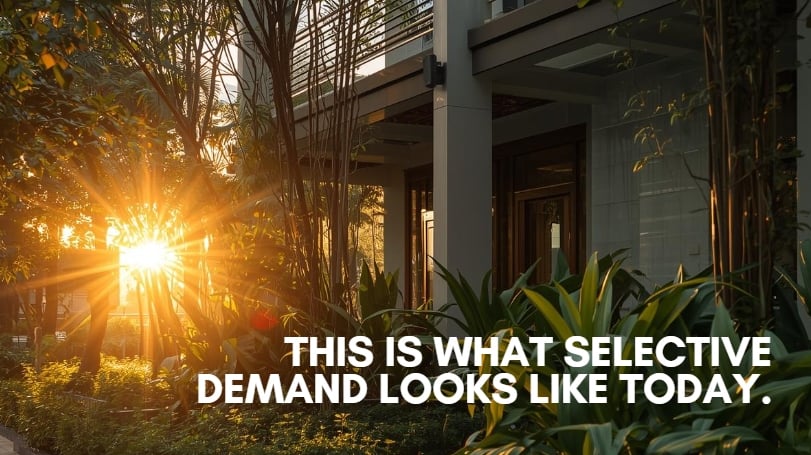
If you want proof of how selective demand behaves today, you don’t need theory, you need examples. Just last week, I broke down a District 23 suburban project that:
- Sold out in under two years
- Achieved an average price of around $2,120 psf
- Did so quietly, without hype or frenzy
This wasn’t speculative demand. It was disciplined, long-term demand, exactly the kind ABSD and SSD encourage.
You can read the full case study here:
If Demand Is Weak, Why Did This District 23 Condo Sell Out So Fast?
This example matters because it shows what “demand” looks like in today’s market — quieter, smarter, and very selective.
If You Already Own a Home, Doing Nothing Is Still a Decision
Here’s an uncomfortable truth I often share privately. Many homeowners think not buying means they are being prudent. But in reality, doing nothing is still an active decision, and it has a cost.
Especially when:
- Singapore private home prices still rose ~3.4% in 2025
- Construction and land costs remain elevated
- New GLS sites continue to be bid at high land rates, keeping replacement prices firm
Your first property likely did three things for you:
- Protected your capital
- Gave you leverage
- Benefited from long-term appreciation
Your second decision is more nuanced. It’s no longer about proving you can buy again. It’s about deciding where incremental capital delivers the best return for the risk taken.
Why Many Singapore Homeowners Feel “Stuck” Right Now
If this sounds familiar, you’re not alone:
- “Prices feel high.”
- “ABSD feels painful.”
- “I’m not sure returns are worth it anymore.”
- “I don’t want to make a mistake.”
These concerns are valid. But here’s something many people overlook:
Despite this hesitation, Singapore property investment reached about SGD 40 billion in 2025, an eight-year high.
So the better question isn’t whether people are buying.
It’s who is still buying, and why?
Who Is Actually Buying in 2025–2026
From what I see on the ground, buyers today fall into three groups.
1. Upgraders with clarity
Families moving for schools, space, or lifestyle.
2. Long-term investors
Those who understand:
- Returns are steadier, not explosive
- Holding power matters more than perfect timing
- Rental income + capital preservation is the strategy
3. Capital allocators
Buyers who treat property as part of a broader portfolio. These are not impulsive buyers. And that’s exactly why projects that still sell well today tend to hold value better tomorrow.
The Real Question You Should Ask Yourself
If you already own a home, ask yourself:
Is my wealth overly concentrated in one asset?
Is my capital keeping pace with inflation?
Am I relying too heavily on my first property to “do all the work”?
If the right opportunity appears, am I positioned to act?
Most homeowners don’t need more property. They need better-placed property.
The Bigger Risk Most Homeowners Don’t See
If you already own a home, the next step isn’t rushing into another purchase. It’s clarity.
- Whether Singapore still fits your strategy
- How ABSD and SSD really affect your numbers
- What kind of holding period actually makes sense
- Whether to wait, reposition, or diversify
This isn’t something headlines or forums can answer properly.
It needs real numbers. Real scenarios. Real trade-offs.
If you'd like to discuss it further, I’m happy to help.
Connect with me now!